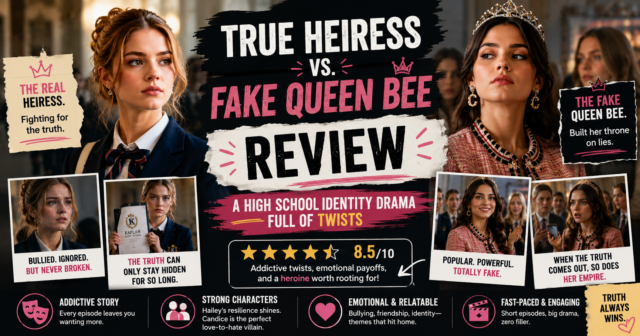
The hidden-identity trope has become one of the most popular formulas in short-form drama, but True Heiress vs. Fake Queen Bee manages to keep the concept fresh by combining high school social warfare, emotional betrayal, and a surprisingly relatable heroine.
At first glance, the series may seem like another story about a rich girl hiding her identity. However, beneath the familiar premise lies an addictive drama packed with shocking twists, frustrating misunderstandings, and a protagonist viewers can’t help but support.
If you’re a fan of stories where the underdog eventually gets justice, True Heiress vs. Fake Queen Bee deserves a place on your watchlist.
Plot Overview
The story follows Hailey Kaplan, the daughter of an extremely wealthy family.
Tired of being defined by her family’s fortune, Hailey transfers to Western High and decides to keep her identity secret. She hopes to experience ordinary teenage life and make genuine friends who appreciate her personality rather than her social status.
Unfortunately, her plan quickly spirals out of control.
Candice Mathis, the daughter of the Kaplan family’s maid, begins pretending to be the real Kaplan heiress. Armed with confidence and a willingness to lie, Candice rapidly becomes the most popular girl in school.
Meanwhile, Hailey finds herself treated like an outsider.
As Candice’s influence grows, Hailey becomes the target of ridicule, bullying, and disbelief whenever she tries to tell the truth.
The result is an emotional battle between authenticity and deception that drives the entire series.
What Makes the Drama So Addictive?
The Frustration Factor
One of the show’s biggest strengths is its ability to make viewers emotionally invested.
Watching Hailey repeatedly tell the truth while nobody believes her can be incredibly frustrating. Yet that frustration becomes the engine that keeps audiences watching.
Every episode leaves viewers hoping that someone will finally uncover the truth.
The longer Candice’s deception continues, the more satisfying the eventual payoff becomes.
Constant Twists and Revelations
The series understands exactly how to maintain suspense.
Just when Hailey seems close to proving her identity, a new obstacle appears. Relationships change, alliances shift, and secrets emerge at just the right moments to keep the story moving.
These twists prevent the drama from becoming repetitive despite its relatively straightforward premise.
High School Social Politics
While the identity conflict drives the plot, the high school setting adds another layer of entertainment.
The show explores:
- Popularity and social status
- Peer pressure
- Bullying and exclusion
- Friendship and loyalty
- Reputation and public perception
These themes help the drama connect with a wide audience, especially younger viewers.
Hailey Kaplan: The Heart of the Story
The success of True Heiress vs. Fake Queen Bee largely depends on its protagonist.
Fortunately, Hailey is easy to root for.
Unlike many wealthy-drama heroines, she is neither arrogant nor spoiled. She actively chooses to leave her privileged life behind because she wants authentic experiences.
What makes Hailey compelling is her resilience.
Despite constant humiliation, she refuses to surrender her integrity. Even when lying would make her life easier, she continues standing by the truth.
Her emotional journey gives the series much of its heart.
Candice Mathis: A Villain You Love to Hate
Every great drama needs an effective antagonist.
Candice fills that role perfectly.
She is ambitious, manipulative, and willing to exploit every opportunity that comes her way. Yet she isn’t simply evil for the sake of being evil.
Her actions are driven by a deep desire for status, recognition, and belonging.
This motivation makes her more interesting than a one-dimensional villain.
Viewers may dislike her choices, but they can understand why she makes them.
Strengths of the Series
1. Easy-to-Follow Storytelling
The narrative is straightforward and accessible, making it ideal for short-drama audiences.
New viewers can quickly understand the conflict and become emotionally invested.
2. Strong Emotional Payoff
The series rewards patience.
Because Hailey suffers so much throughout the story, the eventual moments of justice feel particularly satisfying.
3. Relatable Themes
Despite the wealthy-family backdrop, the drama addresses universal experiences such as being misunderstood, seeking acceptance, and fighting for recognition.
4. Fast-Paced Episodes
The short-format structure keeps the story moving with very little filler.
Every episode introduces new conflicts or developments.
Weaknesses of the Series
No drama is perfect.
Some viewers may find it unrealistic that so many people accept Candice’s claims without demanding stronger evidence. Certain misunderstandings are also stretched longer than necessary to maximize tension.
However, these issues are common within the hidden-identity genre and are unlikely to bother viewers who enjoy dramatic storytelling.
The emotional entertainment value ultimately outweighs the occasional plot convenience.
Who Should Watch This Drama?
True Heiress vs. Fake Queen Bee is a great choice for viewers who enjoy:
- Hidden identity stories
- School dramas
- Revenge narratives
- Rich-girl and fake-heiress plots
- Bully-vs-underdog conflicts
- Female-led dramas
- Emotional redemption arcs
Fans of stories where justice eventually triumphs will likely find the series especially satisfying.
Final Verdict
True Heiress vs. Fake Queen Bee takes a familiar hidden-identity concept and turns it into an entertaining high school drama filled with tension, betrayal, and emotional payoff.
While the premise requires a bit of suspension of disbelief, the engaging characters, addictive twists, and satisfying resolution make it easy to overlook the occasional implausibility.
At its core, the series succeeds because it gives viewers someone worth rooting for. Hailey’s fight to reclaim her identity transforms a simple school drama into a story about integrity, perseverance, and the power of truth.
Explore More About True Heiress vs. Fake Queen Bee
Continue exploring True Heiress vs. Fake Queen Bee with our complete coverage, including reviews, character guides, and ending explanations.
- Is True Heiress vs. Fake Queen Bee Worth Watching? Full Drama Review
- Hailey Kaplan vs. Candice Mathis: Who Is the Real Queen of Western High?
- True Heiress vs. Fake Queen Bee Review: When the Real Heiress Becomes the Outcast
- True Heiress vs. Fake Queen Bee Ending Explained: What Happens to Candice Mathis?
- Candice Mathis Character Guide: The Fake Queen Bee Who Stole Everything
- True Heiress vs. Fake Queen Bee Review: A High School Identity Drama Full of Twists