Introduction
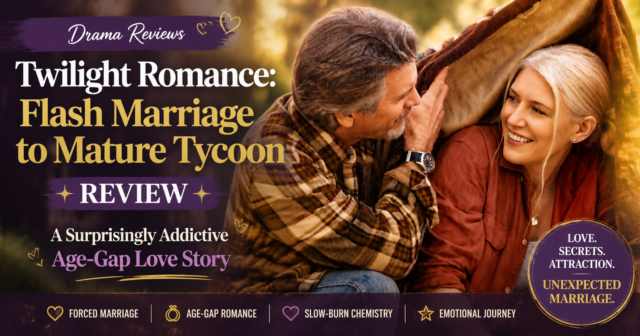
Twilight Romance: Flash Marriage to Mature Tycoon is one of those short dramas that quietly pulls you in before you even realize what’s happening. At first glance, it looks like a familiar setup—an unexpected flash marriage between a younger woman and a wealthy, emotionally reserved older tycoon. But what makes this series stand out is how it balances awkward humor, emotional tension, and slow-burning attraction without losing its addictive pace.
This is not a story that tries to reinvent the genre. Instead, it refines the formula—and in many moments, it hits harder than expected.
A Classic Flash Marriage Setup with a Modern Twist
The core premise revolves around Jocelyn, a young woman trying to navigate an unpredictable life change, and Ray, a mature, composed tycoon who appears emotionally distant but deeply controlled in his world.
Their marriage doesn’t begin with grand romance. It begins with circumstance, awkward encounters, and two people who barely understand each other suddenly forced into proximity.
What makes the setup engaging is not the “why they got married,” but the “what happens after.” The drama leans heavily into the discomfort, hesitation, and emotional restraint that naturally comes with a forced relationship between two people from completely different life stages.
Instead of rushing into romance, the series lets tension build in small, often awkward moments.
The Age-Gap Dynamic That Drives the Story
The age-gap romance element is central to the show’s identity, and it’s handled with a mix of restraint and emotional curiosity.
Ray is written as a mature tycoon who is used to control—of business, of situations, and of himself. He doesn’t easily express vulnerability, which makes his rare emotional slips more impactful.
Jocelyn, on the other hand, brings unpredictability into his structured world. She is not portrayed as naive, but rather emotionally reactive, honest, and sometimes overwhelmed by the intensity of Ray’s presence.
Their dynamic works because it constantly shifts between:
- Authority vs. independence
- Control vs. spontaneity
- Emotional distance vs. sudden closeness
This push-and-pull is what keeps viewers engaged across episodes, especially when misunderstandings and accidental intimacy moments escalate tension.
Romance Built Through Awkward Intimacy
One of the strongest aspects of Twilight Romance is how it builds romance through discomfort rather than fantasy.
Instead of grand romantic speeches, the series relies on:
- Accidental proximity
- Misinterpreted intentions
- Emotional hesitation
- Sudden moments of vulnerability
These small interactions slowly accumulate into something deeper. The chemistry between Ray and Jocelyn doesn’t feel instant—it feels reluctant, which actually makes it more believable within the story’s structure.
Even comedic misunderstandings often carry emotional undertones, hinting that both characters are more affected by each other than they admit.
Emotional Tone and Pacing
The pacing of the series is intentionally uneven in a way that works for short drama storytelling. Some episodes move quickly through conflict, while others slow down to focus on emotional tension or awkward silence between the leads.
This rhythm creates a “hook effect” where viewers feel compelled to continue watching, even if not every moment is action-driven.
The emotional tone can be described as:
- Lightly comedic in early interactions
- Increasingly tense as emotional boundaries blur
- Gradually intimate as trust begins to form
It avoids melodramatic excess while still delivering enough emotional escalation to keep the romance engaging.
Character Chemistry: Ray vs. Jocelyn
Ray is the classic “controlled male lead” archetype, but his strength lies in subtle vulnerability. He doesn’t openly express emotions, but his reactions—especially when Jocelyn disrupts his expectations—reveal more than his words.
Jocelyn is the emotional center of the story. Her reactions feel immediate and honest, which contrasts sharply with Ray’s restraint. This contrast is what creates the core tension of the series.
Their chemistry is not built on perfection. It’s built on friction.
And that friction is exactly what makes their interactions compelling.
What Makes the Drama Addictive
The series doesn’t rely on complex world-building or multiple subplots. Instead, it focuses tightly on emotional interaction between two people forced into an unconventional marriage.
The addictive quality comes from:
- Constant unresolved tension between the leads
- Small emotional “almost moments” that never fully resolve immediately
- The mystery of whether their relationship is real or just circumstance
- The gradual shift from discomfort to emotional dependence
It’s a slow emotional burn wrapped in short-form storytelling.
Strengths and Weaknesses
Strengths
- Strong central chemistry between leads
- Effective use of tension and silence
- Easy-to-follow storyline
- Emotionally driven rather than plot-heavy
- Satisfying romantic buildup
Weaknesses
- Secondary characters are less developed
- Some conflicts feel repetitive in structure
- Predictability typical of the genre
Despite these limitations, the emotional core remains strong enough to carry the series.
Final Verdict
Twilight Romance: Flash Marriage to Mature Tycoon succeeds because it understands its audience. It doesn’t try to be overly complex or dramatically unpredictable. Instead, it focuses on emotional tension, awkward intimacy, and a slowly evolving relationship between two very different people.
If you enjoy age-gap romance, forced marriage tropes, or slow-burn emotional dynamics, this series delivers exactly what it promises—and occasionally, a bit more.
Explore More About Twilight Romance: Flash Marriage to Mature Tycoon
Continue exploring Twilight Romance: Flash Marriage to Mature Tycoon with our complete coverage, including reviews, character guides, and ending explanations.
- Jocelyn Character Guide: The Young Bride Caught in a Flash Marriage to a Tycoon
- Does Twilight Romance: Flash Marriage to Mature Tycoon Have a Happy Ending? Full Explanation
- Twilight Romance Ending Explained: Do Ray and Jocelyn Stay Together After the Flash Marriage?
- Ray Character Guide: The Mature Tycoon Who Changed Everything in Twilight Romance
- Twilight Romance: Flash Marriage to Mature Tycoon Review – A Surprisingly Addictive Age-Gap Love Story
- Twilight Romance Drama Review: A Flash Marriage That Turns Into Unexpected Passion